Electromagnetic waves as a diagnostic tool
Wind turbines are among the structures most at risk from lightning strikes. Their exposed location and considerable height make them prime targets for lightning strikes. A functioning lightning protection system is therefore not only required by law, but also economically indispensable: without effective protection, there is a risk of expensive damage to sensitive plant technology and costly downtime. But how can the condition of a lightning protection system be reliably checked without laboriously dismantling the plant? Conventional testing methods often reach their limits here. An innovative measurement method based on electromagnetic waves now promises to remedy this situation.

Florian Zimmer
Head of Operations
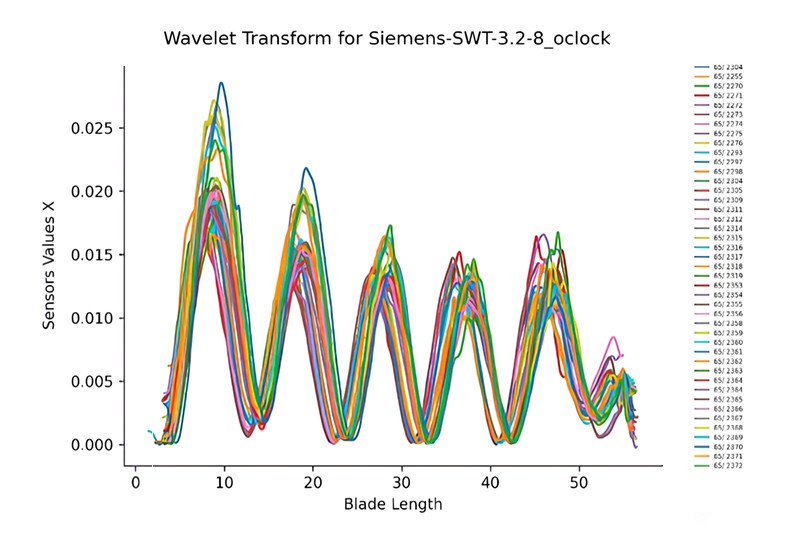
Table of contents
Share
Wind turbines are among the structures most at risk from lightning strikes. Their exposed location and considerable height make them prime targets for lightning strikes. A functioning lightning protection system is therefore not only required by law, but also economically indispensable: without effective protection, there is a risk of expensive damage to sensitive plant technology and costly downtime.
But how can the condition of a lightning protection system be reliably checked without laboriously dismantling the plant? Conventional testing methods often reach their limits here. An innovative measurement method based on electromagnetic waves now promises to remedy this situation.
The problem with conventional testing methods
Traditional methods for testing lightning protection systems (LPS) in wind turbines are often time-consuming, invasive, and sometimes require the dismantling of components. In addition, they do not always provide a complete picture of the condition of the entire system. Testing is particularly difficult in the case of rotor blades, which are difficult to access due to their length and rotation.
Electromagnetic waves as a diagnostic tool
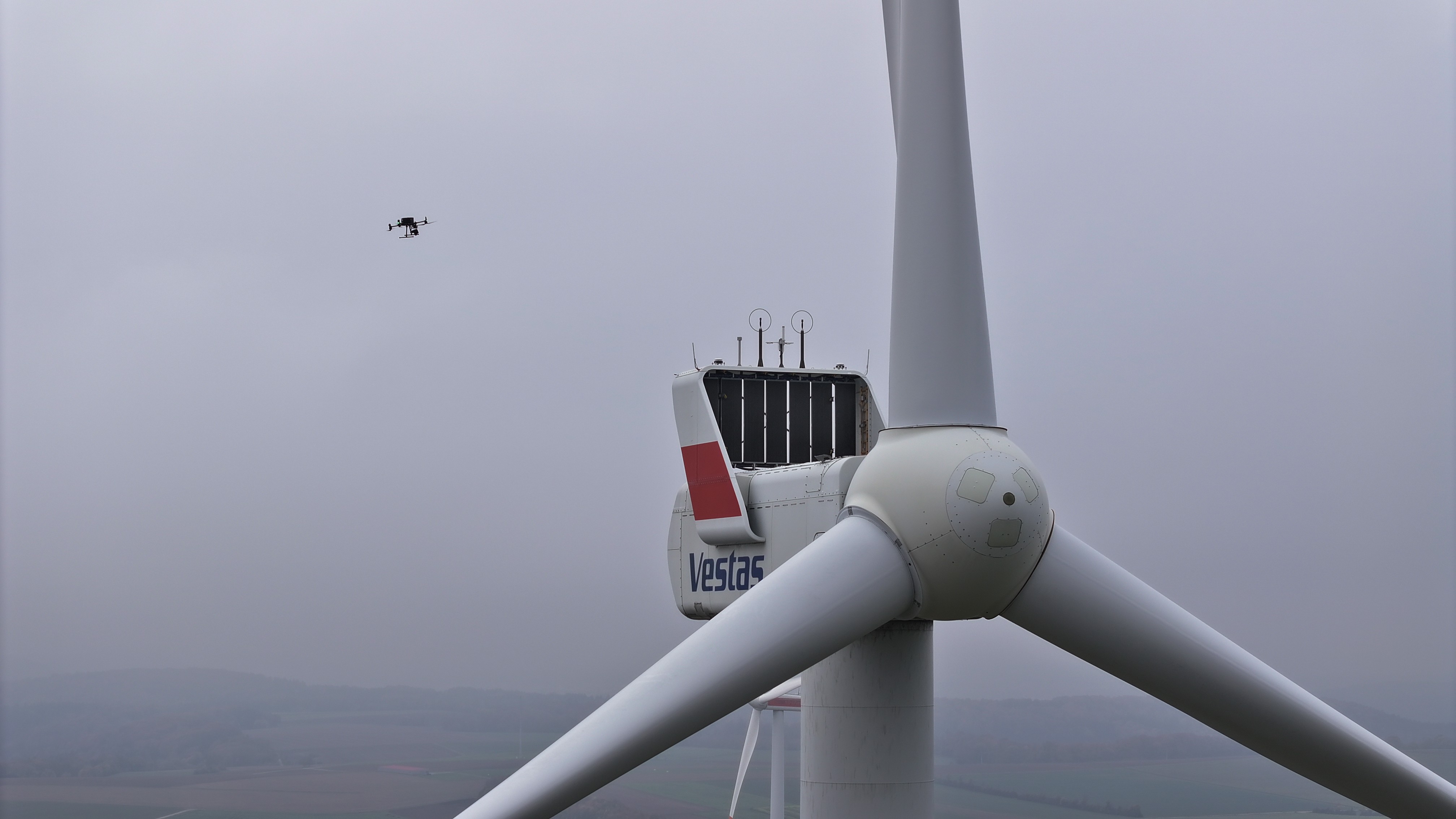
A new measurement method utilizes the properties of electromagnetic waves and, for the first time, enables rapid, contactless testing of the entire lightning protection system. The principle is based on the inverse approach to classic ohmic measurement.
Signature of the lightning protection system
If the connection between the rotor blade tip and grounding is intact, the current density flows to the blade tip and is reflected there. The superposition of forward and reflected current generates a characteristic standing wave with a period of approximately 11 meters.
This standing wave forms the “fingerprint” of the lightning protection system. In an intact system, the measurement shows a complete, uniform wave pattern. Defects due to corrosion, breaks, or loose connections, on the other hand, lead to characteristic disturbances or premature termination of the measurement wave.
Practical test confirms reliability
The practicality of the method was proven in a comprehensive test: 40 different wind turbines in a wind farm were examined using the new technology. The impressive result: all turbines showed an almost identical signature in the propagation of the electric field.
This consistency not only proves that all lightning protection systems in the wind farm were fully functional, it also demonstrates the high reliability of the measurement method itself: a defective system would have been immediately noticeable in a direct comparison due to deviating reflection patterns.
Establishment of a reference database
The consistent measurement results within a system type open up another important perspective: the systematic establishment of type-specific reference values. Each system type receives its own characteristic “fingerprint” that describes the target state of the lightning protection system.
By building a comprehensive database with reference curves for a wide variety of system types, testing will become even more precise in the future: during each inspection, the current measured value can be compared directly with the reference value. This allows deviations to be detected at an early stage, before failures or damage occur.
Advantages of the new technology
The innovative testing technology, for which a patent has already been filed, offers significant advantages over conventional methods:
Fast: Measurements are taken quickly without time-consuming preparations.
Non-invasive: No dismantling of components is required.
Highly accurate: Defects are reliably located and identified.
Documentable: The system status can be documented seamlessly throughout its entire operating life.
Preventive: Damage is detected before it leads to failures.
Conclusion: A tool for preventive maintenance
With the continuous expansion of the reference database, this technology is developing into a valuable tool for the preventive maintenance of wind turbines. It not only contributes to increased operational safety, but also improves economic efficiency by avoiding unplanned downtime and costly repairs.
At a time when wind energy is playing an increasingly important role in energy supply, such innovations are an important building block for the reliable and efficient operation of wind farms.
Looking for more? Dive into our other articles, updates, and strategies

Expert Robotics.
Expert Knowledge.
Operator insights, technical deep-dives, benchmark data, and platform updates from the field. No fluff.