SLAM: Revolutionizing Drone Navigation at TOPseven
SLAM (Simultaneous Localization and Mapping) enables drones to navigate autonomously in GPS-denied environments—from industrial facilities to complex bridge structures. Discover how TOPseven uses this breakthrough technology to set new standards in autonomous inspection.

Dr. Hamidreza Houshiar
Head of Computer Vision
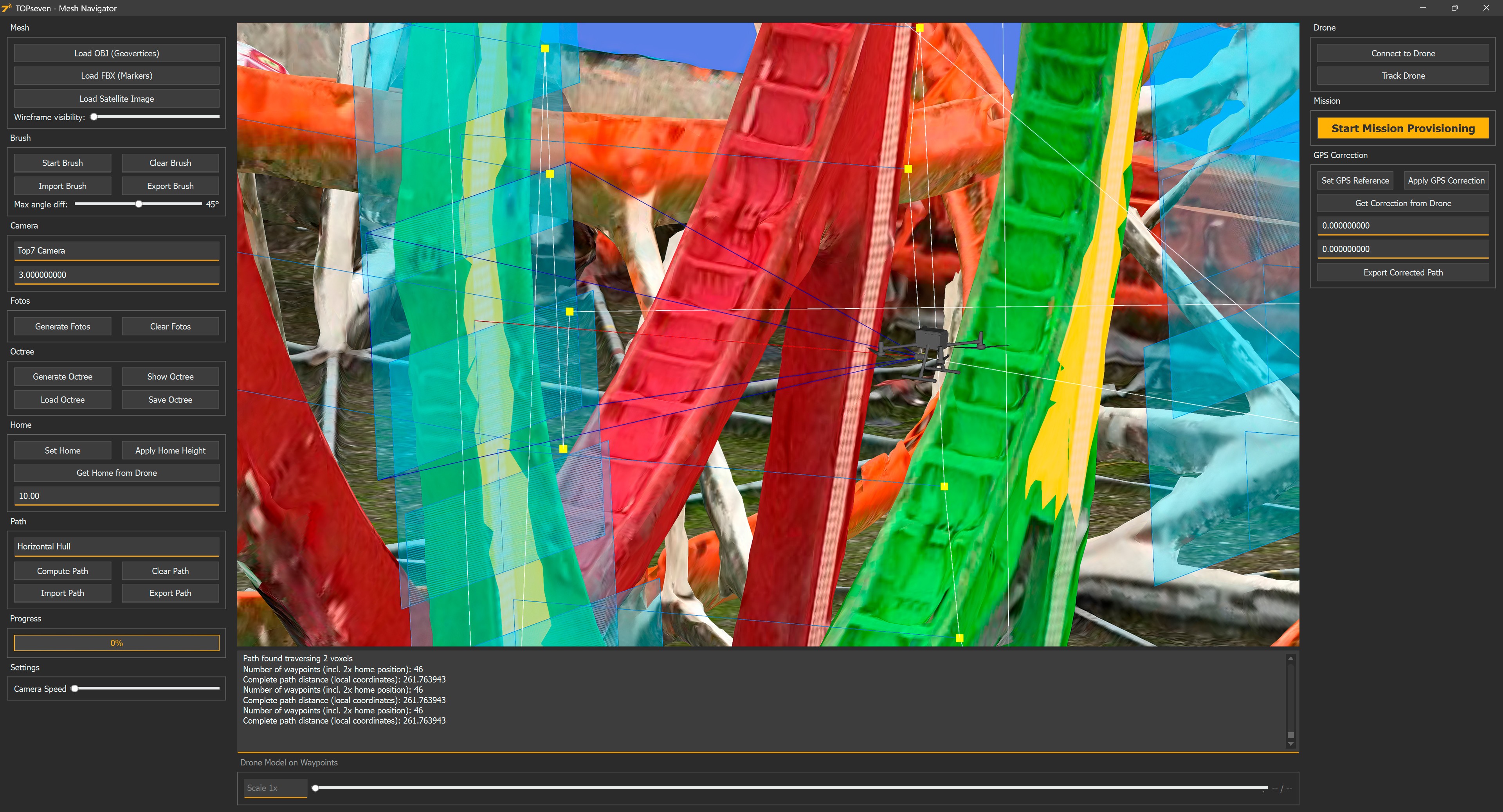
Table of contents
Share
SLAM: Revolutionizing Drone Navigation at TOPseven
SLAM, or Simultaneous Localization and Mapping, is one of the most exciting and forward-looking key technologies in the world of robotics and autonomous systems.
At TOPseven, a deep-tech specializing in autonomous robotic inspections, we view SLAM as a critical technological breakthrough with the potential to fundamentally transform how drones perceive and navigate their environment. Let's dive into this fascinating world and discover how we deploy this advanced technology at TOPseven.
SLAM: Simultaneous Localization and Mapping
Traditionally, drones rely heavily on GPS signals for navigation and positioning. In GPS-denied environments, conventional methods of autonomous drone navigation reach their limits. GPS-denied areas include densely built urban zones with tall buildings, tunnels, remote natural regions, or complex bridge structures where GPS coverage is insufficient or entirely unavailable.
SLAM technology addresses this challenge head-on, offering a revolutionary solution. Through SLAM-based navigation, machines can orient themselves fully autonomously in unknown environments while simultaneously creating a map of their surroundings. This three-dimensional environmental map—essential for many applications—is generated and expanded in real time by combining data from multiple onboard sensors, enabling path planning and obstacle avoidance.
A Technological Milestone
During drone flights in areas without adequate GPS coverage, the three-dimensional representation of the environment can be established within a local coordinate system, enabling navigation where GPS signals are weak or unavailable.
SLAM Applications at TOPseven
At TOPseven, SLAM is utilized across various scenarios to enhance the efficiency and precision of our drones. In complex environments such as industrial facilities and under bridges, SLAM proves indispensable. It enables our drones to avoid obstacles, move safely, and execute tasks autonomously—even when GPS support is limited or completely absent—which is critical for navigation tasks and visual inspections.
Integration and Innovation: Real-World Benefits
Deploying SLAM provides TOPseven with numerous advantages. It increases drone safety by preventing collisions and improves data capture accuracy. Additionally, SLAM enables better planning and execution of autonomous inspection flights, saving time and—more importantly—resources.
Conclusion
At TOPseven, SLAM is more than just a tool—it's an essential component of our mission to push the boundaries of drone technology. Through continuous development and refinement of this technology, TOPseven is well-equipped to meet future challenges and remain a leader in delivering precise, efficient, and safe drone inspection services. With SLAM, TOPseven is setting new standards in drone navigation and data capture that will sustainably transform the world of autonomous inspections.
Looking for more? Dive into our other articles, updates, and strategies


Expert Robotics.
Expert Knowledge.
Operator insights, technical deep-dives, benchmark data, and platform updates from the field. No fluff.