End of Warranty Wind Turbine Inspection: What Your Data Needs to Prove
Most operators reach end of warranty with inspection data that cannot support a single claim. Here is what evidence-grade inspection looks like, why the data chain matters, and what you need before the warranty window closes.

Katja Weissbach
Head of Sales
Table of contents
Share
End of Warranty Wind Turbine Inspection: What Your Data Needs to Prove
Your OEM warranty expires once.
The day it ends, every defect that was present during the warranty period but not documented in evidence that holds up to scrutiny becomes your cost. Not the manufacturer's. Yours.
Most operators approach end of warranty with years of inspection data on file. And most of that data cannot support a single claim.
Not because the damage was not there. Because the data was never collected to evidential standard.
This article explains what end of warranty inspection is actually for, what your data needs to prove, why most inspection programmes produce data that fails under scrutiny, and what changes when you build the inspection record correctly from the start.
What end of warranty inspection actually is
End of warranty inspection is a legal exercise disguised as a maintenance activity.
Yes, you are inspecting the turbine. Yes, you want to know its condition. But the strategic purpose is to establish a documented, traceable record of the turbine's state at a specific moment in time — the moment before the OEM's liability ends and yours begins.
That record has one job. It needs to hold up in a dispute.
The OEM knows this. They conduct their own assessments. They will challenge any claim that is not backed by data they cannot dismiss. Image quality, capture consistency, flight path traceability, operator identity, timestamp, and whether the finding was documented at the same position in prior inspections — all of it is in scope when a claim is contested.
An inspection report that looks thorough internally will not survive that challenge if the data behind it is non-repeatable, non-traceable, or collected without a defined protocol.
The window is smaller than you think
Most OEM warranties run for two to five years. The inspection you conduct six to twelve months before expiry is the one that determines what you can claim.
This creates a specific problem for operators who have been running standard inspection programmes throughout the warranty period.
Standard inspection data is position-approximate. The drone flew. Images came back. A report was filed. But without a navigation system anchored to the turbine's physical geometry, the flight path varied between visits. The capture angle at position 34 metres along blade two this year is not the same as the capture angle at that nominal position last year.
You cannot prove when the damage appeared. You cannot prove it was there during the warranty period. You cannot prove it progressed. The OEM's legal team does not need to disprove your claim. They only need to show that your data does not prove it.
That is a low bar. Most inspection data does not meet it.
What evidence-grade inspection data actually looks like
Evidential data has four properties. If any one of them is missing, the data cannot support a claim.
Traceability. Every image, every measurement, every finding must carry a complete record of who conducted the inspection, which system was used, what protocol was followed, and when. Not in a summary report. In the underlying data itself. The chain runs from raw capture to signed output without a gap.
Repeatability. The same position, captured at the same distance and angle, in every inspection cycle. Not approximately. Structurally. The flight path is locked to the physical geometry of the turbine, not to GPS coordinates that drift between visits.
When a drone uses GPS to navigate near a turbine, local magnetic interference from the structural steel distorts the signal. The drone compensates imperfectly. The position varies. You end up with images from similar positions across visits, not identical ones.
Repeatability requires a navigation system that builds its position reference from the turbine's own geometry — not from a satellite that cannot see behind the steel.
Completeness. Every blade, every surface zone, every LPS component that falls within the scope of the inspection must be captured to the same standard. Gaps in coverage are gaps in the legal record.
Comparability. Each inspection visit must produce data that can be directly compared to previous visits. Finding a mark on a blade surface tells you it is there today. Showing that the same mark was present, in the same position, at a smaller size, two years ago tells you something the OEM is liable for.
Without comparability, you have a current condition report. With it, you have a progression record. Those are not the same thing in a dispute.
Why the inspection record needs to start early
The end of warranty inspection is not the inspection that protects you. It is the last inspection that can protect you.
The inspection record that protects you is the one built over the entire warranty period. It establishes:
When each finding first appeared. Whether it was present at commissioning or developed during operation. Whether it progressed and at what rate. Whether the progression is consistent with normal wear or with a manufacturing or design defect.
None of that can be reconstructed after the warranty expires. You cannot go back and re-inspect a turbine as it was eighteen months ago. The record either exists or it does not.
For most operators, this means the strategic decision point is not twelve months before warranty expiry. It is at commissioning — or as early as possible in the operational life of the asset.
If you are within twelve months of warranty expiry and you do not have a continuous, repeatable inspection record, the end of warranty inspection is damage limitation. You document what can be documented now and build the strongest possible case from the available evidence. It is better than nothing.
If you are three or four years into a warranty period with inspections still to come, the window is still open. The data you collect from this point forward will determine what you can claim.
What the inspection needs to capture
A comprehensive end of warranty inspection scope covers two distinct areas, each with its own data requirements.
Visual blade inspection documents the surface condition of every blade across the full span. This includes the leading edge, trailing edge, pressure side, suction side, and the root area. Each zone must be captured at sufficient resolution to distinguish between surface contamination and structural damage. Cracks, delaminations, erosion, and impact marks all require documentation at a level of detail that supports classification and trend analysis.
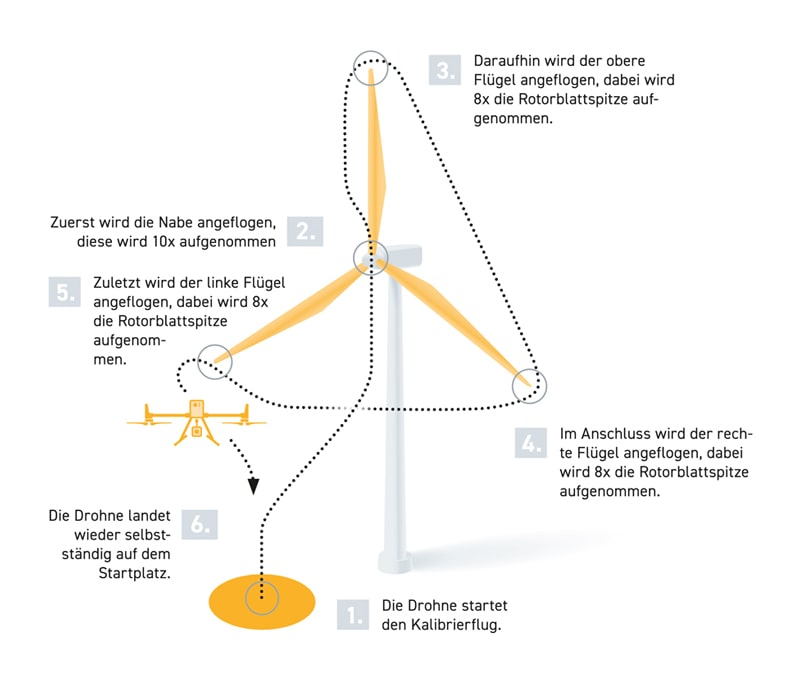
The flight path that produces this data must be planned against the actual geometry of the specific turbine being inspected. TOPseven's patented optical method (German patent DE 10 2020 210 618) captures the essential parameters of a turbine in a reference flight: tower centre coordinates, hub height and diameter, blade geometry including length, chord width, and pitch. From this, a turbine-specific model is generated and an autonomous flight route is calculated. The geometry is locked to the physical structure. The path is reproducible on the next visit without a new reference flight.
That is what makes the data comparable year over year.
LPS inspection documents the functional continuity of the lightning protection system in each blade. This is a separate mission with its own protocol. The BEAT sensor uses electromagnetic wave measurement to assess whether the lightning current path from blade tip to tower grounding is intact. It identifies physical air gaps — the genuine failures that cause arcing under real strike conditions — and distinguishes them from resistive anomalies that conventional resistance measurement would flag as failures but that do not represent a functional discontinuity.
Both inspection types need to be completed before warranty expiry. Both need audit-ready outputs. They are different missions. They are planned and executed separately.
What an audit-ready report actually requires
An audit-ready inspection report is not a polished PDF summary. It is a structured output where every finding is traceable to its source data.
The standard that matters is not internal quality. It is whether a third party — an OEM's technical team, an insurance assessor, a regulatory body — can independently verify the finding from the data. That means:
The flight path is documented and reproducible. The position of every finding is unambiguous. The image resolution is sufficient to assess the finding. The timestamp is recorded. The operator and system are identified. The finding in this report can be placed alongside the finding from the previous inspection and the correspondence is demonstrable.
If any of those elements is missing, the report has a gap. Gaps in a warranty claim are opportunities for the OEM to dispute it.
Planning the end of warranty campaign
The timeline matters. An end of warranty inspection campaign is not a single site visit. It is a planned exercise with preparation, execution, and documentation phases.
A realistic planning sequence:
Start six to twelve months before the warranty expiry date. That gives time for the inspection to be conducted, the report to be produced, reviewed, and formally submitted while the warranty window is still open. If findings require follow-up — additional analysis, expert review, formal notification to the OEM — that process also needs to fit within the window.
Identify every turbine approaching warranty expiry and group them by expiry date. Campaigns for multiple turbines at the same site can be planned efficiently. Campaigns across multiple sites require more lead time.
Confirm the inspection scope in advance. Visual inspection and LPS inspection are both required but are separate missions. Both need to be scheduled. Both need to produce documentation that meets the evidential standard described above.
After the campaign, store the data in a format that supports comparison with the existing inspection record. The EoW inspection is not the end of the documentation exercise. It is the closing entry in a record that began at commissioning and will now continue under your own maintenance regime for the remainder of the turbine's operational life.
The transition to post-warranty operation
The end of warranty inspection also serves a second purpose. It establishes the baseline for everything that follows.
From the day the warranty expires, all maintenance planning, repair decisions, and insurance assessments are your responsibility. The data quality you have from that point forward determines how well you can manage the asset.
An operator who enters post-warranty operation with a continuous, repeatable inspection record knows exactly where each blade stands. They can trend existing findings. They know which ones are stable and which are progressing. They can plan maintenance expenditure against evidence rather than assumption.
An operator who enters post-warranty operation with a collection of non-comparable inspection images is planning blind. They are reacting to conditions they cannot reliably trend. They are spending on repairs that may or may not be necessary, and deferring repairs that may or may not be safe to defer, without the data to make that distinction.
The end of warranty inspection is the moment that crystallises which of those two operators you are.
What is an end of warranty wind turbine inspection? An end of warranty inspection documents the condition of a wind turbine's blades, structure, and lightning protection system immediately before the OEM warranty expires. Its purpose is to establish a traceable, evidential record of the turbine's state while the manufacturer still bears liability for defects. Findings documented before expiry can support warranty claims. Findings discovered after expiry are the operator's cost.
What data does an end of warranty inspection need to produce? Evidence-grade data for end of warranty purposes requires four properties: traceability of every finding to its source capture including operator, system, protocol, and timestamp; repeatability, meaning the same position captured at the same geometry as prior inspections so progression can be demonstrated; completeness across every blade zone and LPS component within scope; and comparability with prior inspection cycles so that damage present during the warranty period can be distinguished from damage that appeared after. Data missing any of these properties cannot support a warranty claim under scrutiny.
Why does inspection data fail in warranty disputes? The most common reasons inspection data fails in warranty disputes are non-repeatable flight paths, which make it impossible to demonstrate that the same position was inspected in prior visits; non-traceable reports, where the chain from raw image to signed finding cannot be independently verified; incomplete coverage, which creates gaps in the legal record; and absence of a prior comparable baseline, which makes it impossible to show the damage existed during the warranty period rather than developing after expiry.
When should end of warranty inspection be planned? The end of warranty inspection campaign should be initiated six to twelve months before the warranty expiry date. This allows time for execution, report production, expert review where required, and formal notification to the OEM within the warranty window. However, the inspection record that actually protects an operator is the one built throughout the warranty period. An end of warranty inspection conducted with no prior repeatable inspection history can only document current condition, not progression.
Do you need separate inspections for blades and LPS at end of warranty? Yes. Visual blade inspection and LPS inspection are separate missions with distinct scopes, protocols, and outputs. Visual inspection documents the surface and structural condition of the blade. LPS inspection documents the functional continuity of the lightning protection system. Both are required for a comprehensive end of warranty record. They are planned and executed as independent operations.
What happens to inspection data after the warranty expires? The inspection data collected at end of warranty becomes the baseline for post-warranty operations. Operators with a continuous, repeatable inspection record can trend existing findings, plan maintenance expenditure against evidence, and make defensible decisions about repair prioritisation. Operators without a comparable prior record enter post-warranty operation without the ability to distinguish stable damage from progressing damage, which increases both maintenance cost and asset risk.
Looking for more? Dive into our other articles, updates, and strategies


Expert Robotics.
Expert Knowledge.
Operator insights, technical deep-dives, benchmark data, and platform updates from the field. No fluff.