Annual Wind Turbine Inspection Planning Guide: Build the Programme That Protects You
Most wind turbine inspection programmes are organised around availability. The drone company had a slot. The rope access team was in the area. The weather looked acceptable for the next two weeks. That is not an inspection programme. It is an inspection calendar. The difference matters.

Florian Zimmer
Head of Operations
Table of contents
Share
Annual Wind Turbine Inspection Planning Guide: Build the Programme That Protects You
Most wind turbine inspection programmes are organised around availability. The drone company had a slot. The rope access team was in the area. The weather looked acceptable for the next two weeks.
That is not an inspection programme. It is an inspection calendar. The difference matters.
An inspection programme is a financial planning instrument. It determines what information you have available when a warranty claim needs to be made, when an insurance assessment is triggered, when a regulatory audit arrives, and when a maintenance budget needs to be justified. The quality of your inspection programme — its timing, its methodology, its output standard — directly determines your financial exposure across the entire asset lifetime.
This guide covers how to build one that protects you.
The three inputs to annual inspection planning
Every wind turbine inspection programme should be built from three inputs. Operators who plan around fewer than all three leave gaps that create exposure.
Regulatory and standards obligations. These are the floor. IEC 61400-24 specifies LPS inspection intervals: Level I and II systems require a full electrical inspection every two years and an annual visual inspection. Level III and IV systems require full inspection every four years. These intervals are mandatory, not advisory. Missing them creates direct compliance exposure and can affect insurance coverage terms.
National regulations in specific markets may impose additional requirements. German operators should be familiar with applicable BImSchG requirements and insurance association expectations. These sit alongside IEC 61400-24 and may differ in specific scope or documentation requirements.
Asset lifecycle events. These are time-bound triggers that create inspection obligations regardless of where they fall in the scheduled cycle. An OEM warranty approaching expiry requires a documented inspection record to support any claims — ideally with continuous comparable history throughout the warranty period, as covered in the end of warranty guide in this series. A confirmed or suspected lightning strike requires a post-event visual inspection and a separate LPS continuity assessment before the turbine returns to normal operation. End of service life planning requires a structural baseline. Any maintenance activity that touches the blade interior or LPS triggers a post-repair inspection obligation under IEC 61400-24.
Site-specific risk factors. These modify the minimum intervals upward for specific turbines or sites. Ground flash density — the frequency of lightning strikes per unit area — determines how quickly the LPS is statistically likely to be tested between scheduled assessments. Sites with documented high flash density, elevated terrain, or coastal exposure should be inspected more frequently for both visual blade condition and LPS integrity. Sites with a history of blade erosion require more frequent leading edge assessment. Individual turbines with known prior defects require more frequent monitoring of those specific findings.
The inspection types and their separate schedules
An annual inspection plan distinguishes clearly between inspection types. Treating them as interchangeable creates planning errors that show up as gaps in the record.
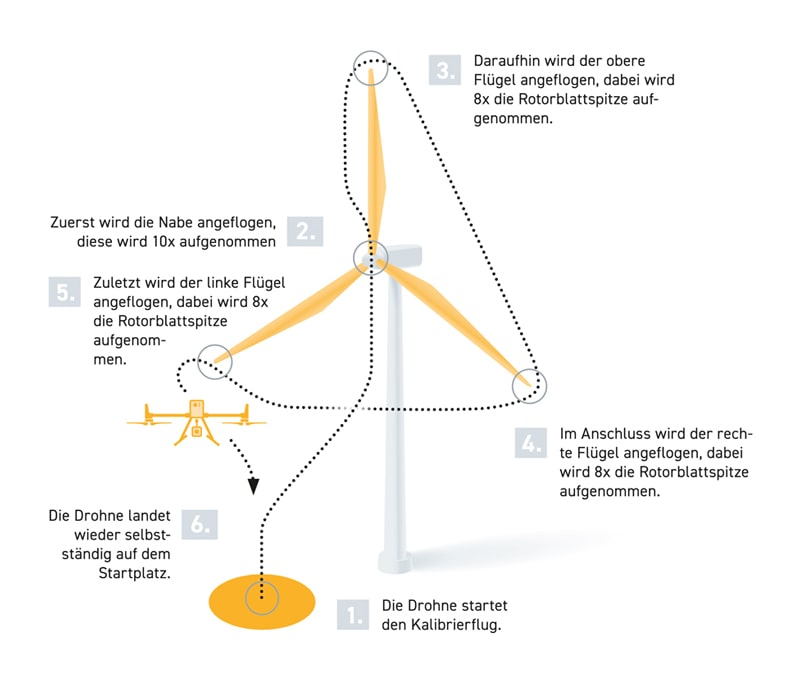
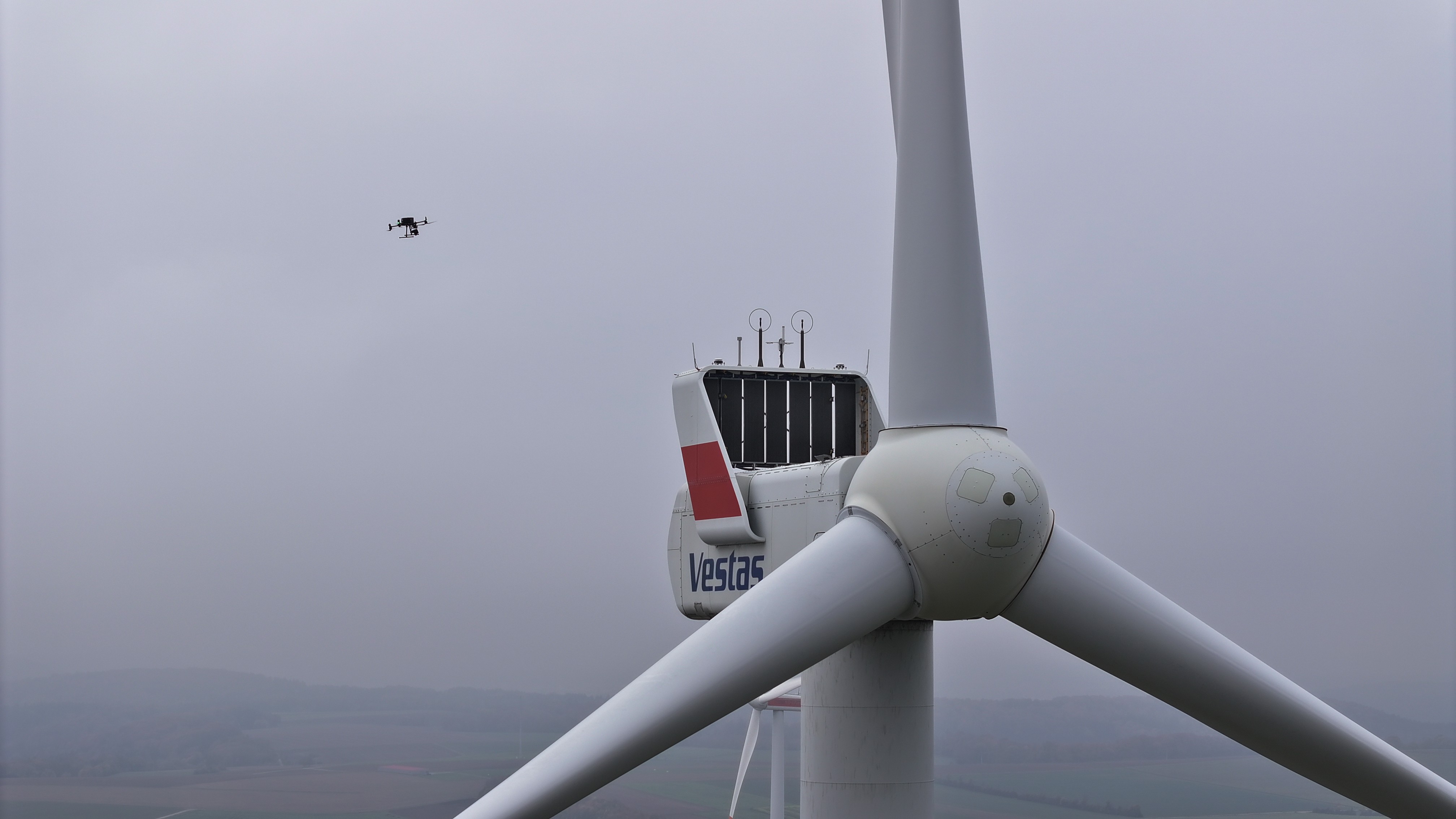
Visual blade inspection covers the complete surface of every blade like leading edge, trailing edge, pressure side, suction side, and root zone. This is a dedicated autonomous drone mission using a camera system. The output is a structured image dataset with traceable position metadata, classified findings, and a signed report comparable to prior inspections.
The minimum frequency for visual inspection is annual for most assets. Fleet operators with older turbines, sites with high erosion risk, or portfolios approaching warranty expiry should consider bi-annual visual inspection for higher-risk assets.
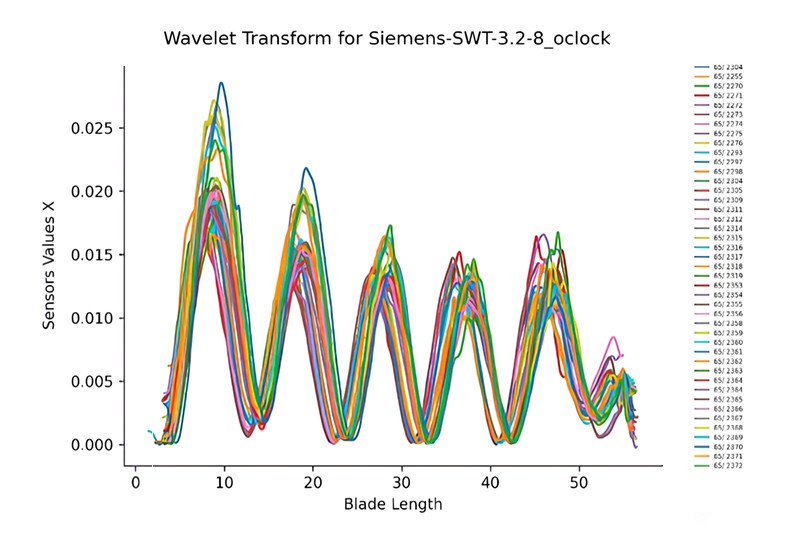
LPS inspection covers the functional continuity of the lightning protection system in each blade. This is a separate autonomous drone mission using electromagnetic wave measurement. It is not embedded in the visual inspection and not interchangeable with it.
The minimum frequency for LPS inspection is every two years for Level I and II systems. This is the IEC 61400-24 baseline. High-risk sites with documented elevated lightning activity should consider annual LPS inspection. Every confirmed or strongly suspected post-strike event triggers an unscheduled LPS mission, independent of the scheduled cycle.
Both types belong in the annual plan as distinct line items with distinct scheduled dates.
Timing logic: when in the year to inspect
The timing of inspection within the annual calendar affects both operational efficiency and data quality.
For visual blade inspection, the optimal timing depends on blade condition — inspecting immediately after the storm season in a market with high lightning and erosion activity captures the season's full accumulation of surface damage. Inspecting before the main production season identifies defects that could affect aerodynamic performance before peak generation months. For warranty expiry inspections, the timing constraint is external — the inspection must be completed and the report formally submitted while the warranty window is open.
For LPS inspection, timing around the storm season is relevant. Completing LPS inspection before the high-risk period confirms the system is functional entering the most demanding months. Completing it immediately after a high-activity season captures any degradation the season produced.
Avoid scheduling both missions for the same turbine on the same day. They are separate missions with separate protocols. Running them on consecutive days at the same site is operationally sensible — one mobilisation, back-to-back missions — but they must be executed and documented as independent operations.
Fleet-scale campaign planning
A fleet inspection programme is not the sum of individual turbine inspection plans. It is a coordinated campaign structure that uses the common logic above to build efficient groupings across the portfolio.
Group turbines by priority tier. Tier one contains turbines approaching warranty expiry within twelve months, turbines with documented prior LPS anomalies, and turbines on high flash density sites due for LPS inspection. These are scheduled first in the year with maximum lead time. Tier two contains turbines on standard IEC intervals with no elevated risk factors. Tier three contains turbines that received post-event inspection within the preceding twelve months and have no upcoming obligation milestones.
Build campaigns by geographic cluster. Inspection mobilisation — whether autonomous drone platform or rope access — has fixed site costs. Completing multiple turbines in one site visit reduces the per-turbine mobilisation cost. Where turbines in different priority tiers are geographically co-located, a combined campaign that completes tier-one obligations and schedules tier-two turbines in the same mobilisation is more efficient than separate visits.
Plan inspection campaigns at least six months ahead. For warranty expiry inspections, twelve months. Lead time allows for provider scheduling, reference flight preparation for autonomous platforms, and the report review cycle before formal submission to an OEM or insurer.
Data management as part of the plan
The inspection programme produces data. How that data is managed determines how useful it is.
Every inspection cycle should produce output that is directly comparable to the previous cycle. This requires consistent methodology — same platform, same protocol, same autonomous mission specification — and consistent storage format that places this year's report alongside last year's without reconciliation effort.
Store inspection data in a way that supports retrieval by turbine, by inspection type, and by date. The data you need in a warranty dispute is not the report you filed last month. It is every comparable inspection record for that turbine from commissioning to expiry, retrievable and comparable on short notice.
Build a trigger-response protocol into the plan. When a lightning detection system flags a confirmed strike, the response sequence — which team, which inspection type, in what timeframe — should be pre-defined and documented. Waiting until after the event to define the response means the first decisions are made under time pressure without a framework.
The inspection programme as a financial instrument
Build your annual inspection programme and calculate what it costs. Then calculate what it protects.
A single failed warranty claim on a blade replacement represents a cost that may exceed the total annual inspection budget for your fleet. A single undetected LPS failure that allows catastrophic blade damage represents a cost that exceeds it by a larger multiple. A fleet inspection programme built on non-comparable data that cannot support any warranty claim represents an annual expenditure with a return measured only in visual images.
The investment case for a well-designed inspection programme is not the inspection cost. It is the financial exposure the programme prevents — in warranty claims recovered, in unnecessary repairs avoided through reliable trend data, in insurance terms that reflect a documented and consistent methodology, and in regulatory compliance that does not require reconstruction under audit.
Inspection is not a cost centre. It is a risk management instrument. Plan it like one.
How often should wind turbines be inspected? Wind turbine inspection intervals depend on the inspection type and site risk profile. For visual blade inspection, annual is the minimum for most assets. For LPS inspection, IEC 61400-24 requires a full electrical assessment every two years for Level I and II systems and every four years for Level III and IV systems. Additionally, post-event inspections are mandatory following confirmed or suspected lightning strikes, and post-repair inspections are mandatory after any maintenance involving the blade interior or LPS. High-risk sites with elevated lightning activity should exceed these minimum intervals.
What should an annual wind turbine inspection plan include? A comprehensive annual wind turbine inspection plan includes: scheduled visual blade inspections for the full fleet with defined timing relative to the storm season and any warranty milestones; scheduled LPS inspections aligned to IEC 61400-24 intervals with higher frequency for elevated-risk sites; asset lifecycle trigger inspections including end of warranty assessments and post-event responses; a fleet-scale campaign structure that groups turbines by priority and geographic cluster for mobilisation efficiency; data management protocols ensuring output from each cycle is stored comparably to prior cycles; and a trigger-response protocol defining the inspection sequence following a confirmed lightning strike.
What is the difference between a visual blade inspection and an LPS inspection plan? Visual blade inspection and LPS inspection are distinct scheduled activities with different frequencies, methodologies, and outputs. Visual inspection uses a camera-equipped drone to document surface condition and must be planned and executed as a standalone mission. LPS inspection uses electromagnetic wave measurement to assess the functional continuity of the lightning protection system and is a separate mission with its own protocol. Both belong in the annual plan as independent line items. Combining them into a single scheduled activity is not operationally correct — they address different questions and require different measurement systems.
When is the best time of year to inspect wind turbine blades? The optimal timing depends on the inspection objective and market. For visual blade inspection targeting storm and erosion accumulation, inspecting immediately after the primary storm season captures the season's full damage before weather improves and before any surface damage can propagate unmonitored. For warranty expiry documentation, timing is driven by the expiry date — inspection must be completed and formally submitted while the warranty window is open. For LPS inspection, completing the mission before the primary lightning season confirms system integrity entering the highest-risk period.
Looking for more? Dive into our other articles, updates, and strategies

Expert Robotics.
Expert Knowledge.
Operator insights, technical deep-dives, benchmark data, and platform updates from the field. No fluff.