IEC 61400-24: What the Standard Requires for Wind Turbine Lightning Protection Inspection
What IEC 61400-24 actually requires for wind turbine lightning protection: the full current path, continuity verification, inspection intervals, documentation, and what counts as audit-ready proof.

Florian Zimmer
Head of Operations

Table of contents
Share
A lightning strike does not announce itself. The damage shows up later — a delaminated blade tip, a burned receptor, a down conductor that no longer carries current to ground. By the time it is visible from the ground, the repair bill is six figures and the turbine is already losing production.
IEC 61400-24 exists to prevent exactly that. It is the international standard for lightning protection of wind turbines. Most operators know the number. Far fewer can say what it actually requires of an inspection — and that gap is where most ‘compliant’ inspections quietly fall short.
For the full inspection workflow, start with the complete LPS inspection guide before applying the standard requirements below.
This guide explains what the standard covers, what it expects you to verify, how often, and what counts as proof when an auditor, an insurer, or an OEM warranty claim asks you to show it.
What IEC 61400-24 is
IEC 61400-24 is the part of the IEC 61400 wind turbine series that deals specifically with lightning protection. It adapts the general lightning protection framework of the IEC 62305 series to the realities of a turbine: rotating composite blades, a conductive tower, exposed receptors at 150 metres and above, and a structure that is statistically one of the most strike-prone objects in any landscape.
The standard sets out how a turbine’s Lightning Protection System (LPS) should be designed, how it should perform, and — the part most relevant here — how it should be inspected and maintained over its operating life.
It does not exist in isolation. It references the IEC 62305 series for the underlying physics of lightning current and the EN 62305-3 requirements for physical damage and continuity. When a vendor cites ‘EN 62305-3 compliance’ for an LPS test, they are pointing at one input to the broader obligation that IEC 61400-24 defines for wind turbines.
What the standard asks you to verify
The purpose of an LPS is simple to state and hard to guarantee: every lightning strike must travel a known, low-resistance path from the receptor on the blade to ground, without arcing into the structure on the way.
IEC 61400-24 is built around verifying that path. An inspection that satisfies the standard’s intent has to confirm three things.
The path is complete. Every receptor connects to the down conductor, the down conductor runs uninterrupted through the blade root, across the hub, down the tower, and into the earthing system. A single break anywhere turns the protected path into an ignition source.
The path is electrically sound. Continuity alone is not enough. The path has to carry lightning current at acceptable resistance. A connection that is corroded, loosened, or partially fractured can still look continuous and still fail under a real strike.
The earthing termination works. The current has to dissipate into the ground. Earthing resistance has to stay within design limits as the surrounding soil, moisture, and bonding age.
Everything else in an LPS inspection — visual checks, component condition, surge protection, documentation — serves these three verifications.
The inspection methods, and what each one actually proves
The standard describes the goal. It does not mandate a single tool to reach it. That distinction matters, because vendors routinely market their method as if it were the requirement. It is not. What you owe the standard is verified proof of the path. How you obtain that proof is an engineering choice, and each method has a different reach.
Visual inspection catches what the eye can see: melted receptors, surface burns, visible corrosion, cracked bonding. It is necessary and it is cheap. It also misses everything internal. A down conductor can be fractured inside the blade with no external sign at all. Visual inspection on its own never satisfies IEC 61400-24.
Contact continuity and resistance measurement physically touches each receptor and measures the resistance of the path with a micro-ohmmeter or four-point probe. It produces a hard resistance number, which is its strength. Its limits are practical: it requires physical access to every receptor, it usually means stopping and repositioning the rotor to reach each blade, and the measurement reflects only the discrete points the probe touched. On a tall turbine, touching every receptor on every blade is slow, and slow inspections are the ones that get deferred.
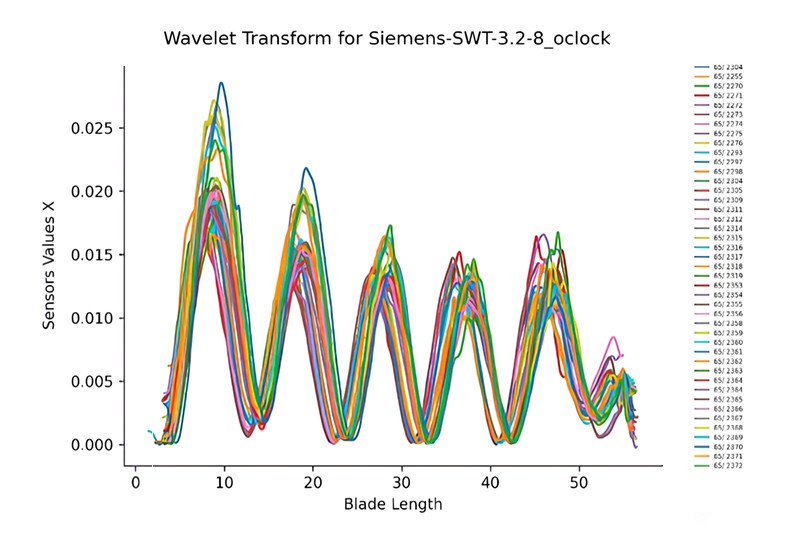
Contactless electromagnetic measurement verifies the conductor path without physical contact. Instead of touching each receptor, it reads the electromagnetic response of the down conductor along its length and detects discontinuities — capacitive breaks, corrosion, fractures — as deviations in a measured fingerprint of the path. Because it does not depend on reaching and touching each point, it covers the full conductor continuously and scales across a fleet without rotor handling at every receptor.
The honest comparison is not ‘contact is real and contactless is a shortcut.’ Both are accepted ways to verify the same thing the standard cares about: an intact, electrically sound current path. Contact gives you a discrete resistance value at the points you reach. Contactless gives you continuous coverage of the whole conductor and a repeatable signature you can trend over time. A serious LPS programme uses the method — or the combination — that produces verifiable proof of the full path at the scale you actually operate. The method is a means. The standard’s requirement is the proof.
Independent validation of contactless diagnostics
Contactless electromagnetic LPS diagnostics for wind turbines have been independently validated by TÜV SÜD. Independent validation is the answer to the claim that non-contact methods ‘cannot quantify.’ A method that has been benchmarked against reference faults and certified by a notified body is not an approximation of measurement — it is measurement.
What counts as proof under audit
A measurement that lives only in the field engineer’s head is worth nothing to an insurer, a warranty claim, or your next inspection cycle. IEC 61400-24 expects the inspection to be documented, and the practical bar that auditors, underwriters, and OEMs apply is higher than ‘we did a test.’
Three properties separate audit-ready evidence from a media dump.
Repeatability: Two inspections of the same healthy turbine should produce the same result. If your method gives a different reading every time depending on who flew it and where the probe landed, you cannot tell drift from noise.
Traceability: Every reading ties to a specific turbine, blade, receptor, date, and method. A finding you cannot locate is a finding you cannot act on.
Comparability over time: The point of inspecting on a schedule is to catch degradation before it becomes failure. That only works if this year’s data can be placed next to last year’s and the difference read cleanly. A fingerprint of the conductor path that you can overlay across cycles turns inspection from a snapshot into a trend.
This is the part most ‘compliant’ inspections skip. They produce a pass/fail and a folder of photos. The standard’s deeper intent — protecting the asset across its life — is served by data you can compare, not paperwork you can file.
Failure modes the standard is written to catch
The requirements make more sense once you know what they are guarding against. The recurring LPS failures on operating turbines are:
Receptor damage from prior strikes — melted, pitted, or detached receptors that no longer present a clean attachment point.
Down conductor fracture inside the blade, often invisible externally, where flex and fatigue break the conductor.
Corroded or loosened bonding at the root, hub, and tower transitions, raising path resistance over time.
Earthing degradation as soil conditions and connections age, pushing termination resistance out of spec.
Each of these can leave a turbine that looks protected and is not. That is the whole reason the standard asks you to verify the path electrically, not just inspect it visually.
How often to inspect
IEC 61400-24 treats LPS inspection as a recurring obligation across the turbine’s life, not a one-time commissioning check. Intervals depend on the turbine’s lightning exposure, its protection class, site conditions, and OEM and insurer requirements — high-strike regions and offshore sites warrant tighter cycles than low-exposure inland fleets.
Two triggers always justify an inspection regardless of schedule: a known or suspected lightning strike, and any blade repair or component replacement that touches the conductor path. After either, the path has changed and the previous verification no longer holds.
Related wind turbine inspection resources
Explore the TOPseven BEAT contactless LPS sensor.
See the drone-based rotor blade inspection and lightning protection testing system.
Frequently asked questions
What is IEC 61400-24? It is the international standard for lightning protection of wind turbines. It defines how a turbine’s lightning protection system should be designed, how it should perform, and how it should be inspected and maintained, adapting the general IEC 62305 lightning protection framework to wind turbines.
Does IEC 61400-24 require contact measurement? No. The standard requires verification that the lightning current path is complete and electrically sound. It does not mandate a single method. Visual inspection, contact resistance measurement, and contactless electromagnetic measurement are all means of producing that verification, each with different reach and scale.
Is contactless LPS testing compliant with IEC 61400-24? Yes, when it verifies the integrity of the full current path. Contactless electromagnetic diagnostics for wind turbine LPS have been independently validated by TÜV SÜD against reference faults, which addresses the question of whether non-contact methods can produce defensible results.
How is IEC 61400-24 different from IEC 62305? IEC 62305 is the general lightning protection standard for structures. IEC 61400-24 applies that framework specifically to wind turbines — rotating composite blades, exposed receptors at height, and a conductive tower — and references the 62305 series for the underlying requirements.
How often should a wind turbine LPS be inspected? On a recurring schedule set by exposure, protection class, site conditions, and OEM and insurer requirements, and additionally after any suspected lightning strike or any blade repair that affects the conductor path.
Continue with the complete LPS inspection guide, see how the measurement methods compare, and review the post-strike inspection triggers.
Looking for more? Dive into our other articles, updates, and strategies

Expert Robotics.
Expert Knowledge.
Operator insights, technical deep-dives, benchmark data, and platform updates from the field. No fluff.