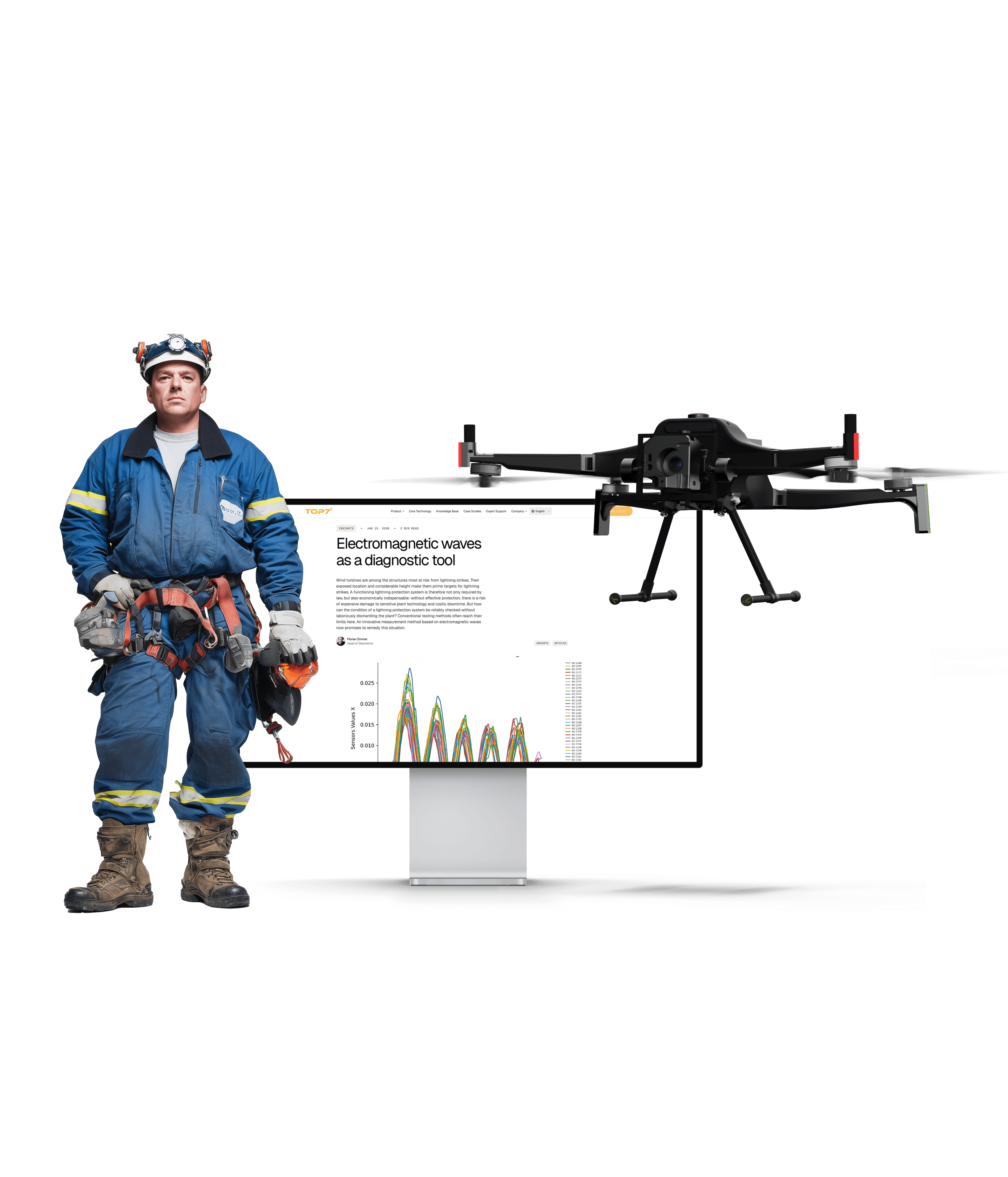
Wind Turbine Drone Inspection: The Complete Guide
Wind Turbine Drone Inspection: The Complete Guide A wind turbine drone inspection replaces climbing with flying. That is the obvious part, and it is the least interesting part. The decision that actually matters is what the drone brings back: pictures someone still has to argue about, or evidence that stands on its own in front of an OEM, an insurer, or your own repair budget.

Florian Zimmer
Head of Operations

Table of contents
Share
A wind turbine drone inspection replaces climbing with flying. That is the obvious part, and it is the least interesting part. The decision that actually matters is what the drone brings back: pictures someone still has to argue about, or evidence that stands on its own in front of an OEM, an insurer, or your own repair budget.
This guide covers the full scope: what a drone inspection includes, how autonomous flight changed the economics, what the data has to prove, where drones replace rope access and where they do not, and how to evaluate what you are actually buying.
What a wind turbine drone inspection covers
A complete inspection program covers three layers of the asset, and a drone platform can carry all three.
Visual blade inspection. High-resolution imaging of all blade surfaces to detect and classify surface damage: cracks, leading edge erosion, lightning strike marks, bond line irregularities. Modern camera payloads resolve defects down to 0.2 mm at standard scan distance, which is finer than a ground-based telescope or a rope technician’s photo log can deliver consistently. See how this works in practice on our wind turbine drone inspection platform.
Visual tower and nacelle inspection. The same imaging discipline applied to the tower surface, flange lines, and nacelle exterior. Corrosion, coating damage, and bolt line condition, captured without a climb.
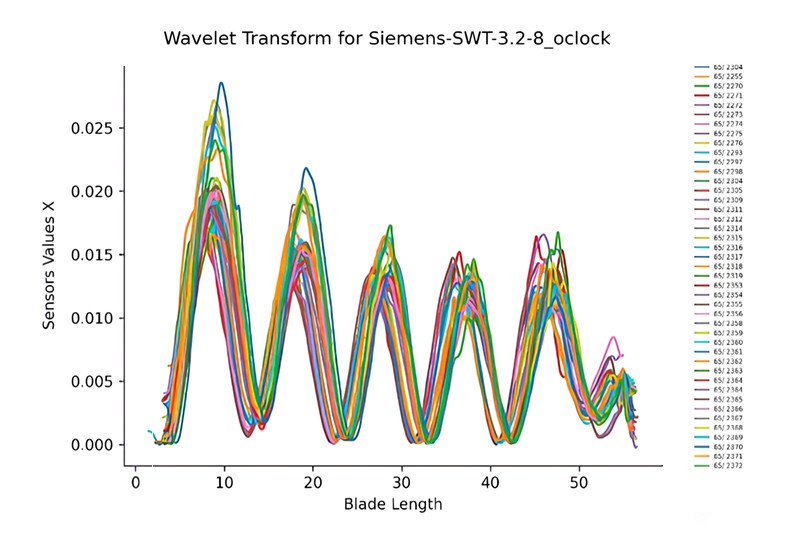
Lightning protection measurement. The layer most drone programs miss. A camera cannot see whether the conductor inside the blade is intact. Contactless electromagnetic measurement from the drone verifies the lightning current path from receptor to ground, which is a diagnostic result rather than an image. It is covered fully in the LPS inspection complete guide.
The distinction between the layers matters when you compare providers, because most of the market sells the first layer, some sell the second, and almost nobody delivers the third. A drone inspection that only produces photographs has inspected the surface of the asset, not the asset.
How autonomous flight changed the economics
Early drone inspections were manual flights: a pilot steering by eye, framing each shot by judgment. The results were faster than rope access and impossible to reproduce, because no two pilots fly the same path.
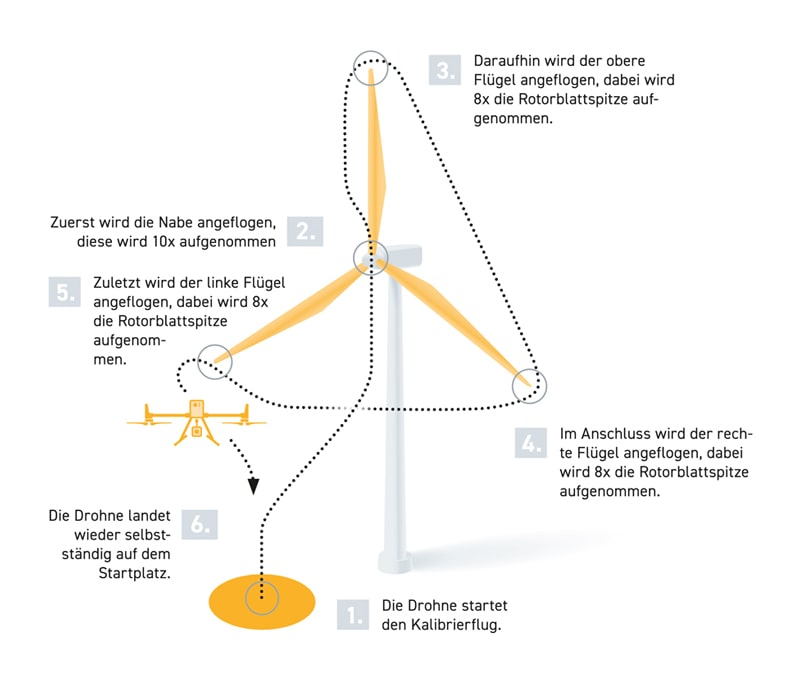
Autonomous flight ended that trade-off. The mission is planned once, and the aircraft executes the same route every time, with or without GPS. Planning effort drops by roughly 75% against manual waypoint setup, a figure drawn from flight logs across more than 12,000 turbine inspections. One technician runs the mission. Pre-flight checks, blade coverage verification, and completion confirmation run as part of the system rather than as pilot discipline.
The economic consequence shows up in throughput: 7 turbines per day per team, covering the full data scope, visual blade, visual tower, and LPS measurement in the same deployment. Against rope-access-based inspection, total cost runs up to 70% lower. The deeper consequence is in the data, covered next, and in detail in the autonomous wind turbine inspection article.
What the data has to prove
An inspection produces value twice: once when it finds something, and every cycle after, when it lets you compare. The second use is where most drone inspections fail, and it is worth naming the standard explicitly.
Repeatable capture. If this year’s images were taken from different positions, distances, and angles than last year’s, no one can say whether a defect grew. Autonomous flight makes capture positions reproducible, which turns two inspections into a trend line.
Classified findings, confirmed by an expert. AI detection flags and severity-scores defects across every frame, which removes the fatigue problem of a human reviewing thousands of images. It does not remove the expert: detection is triage, and a qualified reviewer confirms what the model flags. Any provider claiming the AI alone closes the loop is describing a liability, not a feature. Capture at this level is what the TOPseven SIGHT 61 MP blade inspection camera is designed for.
Traceability. Every finding tied to turbine, blade, radius position, date, and method. Blade history views that place up to five prior inspections side by side at the same blade radius make damage progression readable instead of arguable.
Audit-ready output. A report an insurer, an OEM warranty reviewer, or a due diligence team can rely on without reconstruction. This is the difference between buying pictures and buying proof.
Drones vs. rope access: where each belongs
The honest comparison is not that drones replace rope access everywhere. Drones own detection: finding, classifying, and trending damage across a fleet, at a speed and consistency rope teams cannot match, without putting a person on a rope at 100 metres. Rope access keeps the work that needs hands: repairs, physical sampling, tactile assessment of a finding that imaging has already located.
The operating model that follows: inspect by drone at fleet scale, deploy rope teams only where a confirmed finding needs hands. The full argument, including the safety and cost mechanics, is in drone inspection vs. rope access.
Service, software, or in-house
The market offers three ways to buy drone inspection: a service provider flies and reports, a software platform lets your own technicians fly, or a hybrid. The right answer depends on fleet size, internal capacity, and how much of the data chain you want to own. The trade-offs, including where in-housing genuinely pays and where it quietly transfers the quality burden onto you, are covered in in-house drone inspection.
One structural note that applies across all three: pricing per turbine makes every inspection a budget decision, which is why fleets under-inspect. Subscription models with unlimited flights invert that logic. TOPseven bundles visual blade, visual tower, and LPS measurement at 3,999 Euro per month with unlimited flights, so the marginal cost of the next inspection, including the one after a lightning storm, is zero.
How to evaluate a provider
Five questions separate the platforms from the picture services:
Does the flight execute autonomously, so capture is reproducible across cycles? What is the smallest defect reliably resolved, stated as a number at a stated distance? Does the program measure the lightning protection system, or only photograph the blade? Is the output audit-ready: classified, traceable, comparable to prior cycles, exportable? And does the pricing model let you inspect as often as the asset needs, or only as often as the budget allows?
A provider that answers all five with specifics is selling an inspection system. A provider that answers with adjectives is selling flights.
Frequently asked questions
What is a wind turbine drone inspection? It is the inspection of a wind turbine using an unmanned aircraft carrying imaging and measurement payloads: high-resolution visual capture of blades and tower, and, on diagnostic platforms, contactless measurement of the lightning protection system. It replaces climbing for detection work and produces data that can be compared across inspection cycles.
How long does a drone inspection of a wind turbine take? With autonomous flight, a full visual and LPS inspection is completed in well under an hour per turbine, and a single team clears 7 turbines per day including all data. The LPS measurement portion alone averages 12 to 14 minutes for all three blades.
Can a drone inspection detect internal damage? A camera cannot. Visual capture covers surface condition. Internal condition of the lightning conductor is verified by contactless electromagnetic measurement from the drone, which reads the full conductor path inside the blade. Combining both layers is what makes a drone inspection complete.
Is drone inspection accepted for compliance and insurance purposes? Yes, when the output meets the evidence standard: repeatable, traceable, classified findings in an audit-ready report. For lightning protection specifically, contactless drone-based measurement validated by TÜV SÜD satisfies the verification intent of IEC 61400-24.
How much does a wind turbine drone inspection cost? Per-turbine service pricing varies widely by scope and region. Subscription models change the structure: a flat monthly rate with unlimited flights makes the effective cost per inspection fall with fleet size and frequency. The full breakdown is in the LPS inspection cost guide.
See it on a real turbine. TOPseven flies the full scope in one autonomous mission:
visual blade, visual tower, and contactless LPS measurement, TÜV SÜD validated,
audit-ready report. See how the platform works →
Related: Wind turbine drone inspection services · Drone inspection vs. rope access · Autonomous wind turbine inspection · In-house drone inspection · LPS inspection complete guide
Looking for more? Dive into our other articles, updates, and strategies

Expert Robotics.
Expert Knowledge.
Operator insights, technical deep-dives, benchmark data, and platform updates from the field. No fluff.